When Capitalism and Communism Coexist
German 266, Questions of Political Theology, Stanford · March 2023 · PDF
I. Introduction
In Joseph Rotblat’s acceptance speech of his Nobel Peace Prize in 1995, the physicist propounded, “the Cold War is over but Cold War thinking survives.” Culturally, the Cold War asserted an attitude in American minds about the clashing nature of capitalism and communism. From “better dead than red” to a poster displaying “the communist conspiracy versus our democratic heritage”, the political rhetoric of the Cold War era depicts the socioeconomic theories upheld by the two nation-states as dueling opposites. From an academic lens, an analysis across multiple axes suggest key distinctions between capitalism and communism. Most notably, means of production are privately owned in a capitalist society, whereas there is no existence of private property in a communist state. This article evaluates these two theories across other axes as well, such as individualism versus collectivism, elitism versus egalitarianism, conservatism versus progressivism, and a focus on rationality versus human-nature, all of which are further expanded upon in Section II. In examining three different societies—Stanford, Beijing, and Corvallis—this paper notes the ability for the qualities of capitalism and communism to coexist within the same social and economic system.
The complex combination of seeming opposites can in ways cooperate, and it may precisely be at this junction—where capitalistic notions intersect with communist ideals—that the best societies flourish. In this paper, the definitions of capitalism and communism are not strictly applied in the socioeconomic and political sense, but also in a cultural context to examine the possibility of overlap in these two theories and ideologies. Repeatedly, the theme of moral and religious righteousness emerges, especially in the context of forming the basis and motivations for the establishments of socioeconomic systems such as capitalism and communism.
Weber’s Theory of Capitalism
An examination into German sociologist Max Weber’s theory on the capitalist spirit provides insight into the various qualities of capitalism. In The Protestant Ethic and the Spirit of Capitalism, Weber aimed to understand the contributing factors toward the development of modern capitalism. Weber evaluated various Protestant denominations and argued that Protestantism—and in particular, Calvinism—gave rise to the capitalist spirit.
Calvinism heavily emphasized the doctrine of predestination, that God had unalterably set for eternity who would and would not be saved. In Weber’s theory, this doctrine influenced Calvinist thinking to imagine life as a solo journey, as no one could save the individual. As a result, individuals experience an immense sense of loneliness and solitude, and as a psychological byproduct, Calvinists tend to avoid sensual and emotional matters. Rather, they focus on self-control, rationality, and a systematic approach to life.
Weber argued that this Western rationalism, bred out of ascetic Protestantism, was heavily correlated with Western economic conditions, specifically that of modern capitalism. Further, Weber argued that Protestantism's regard for worldly asceticism—how activities in the everyday world can prove faith—marked influential for the Protestants’ need to seek success in worldly activities. The pursuit of profit and material success gave clues regarding God’s pre-determination of one’s fate. In this sense, because performing well at one’s vocation or “calling” is the meaning of one’s life, then the accumulation of wealth and profit is an end in itself, not a means to an end. Earning money through labor, in the Protestant’s view, is virtuous and fulfills one’s greater calling to do God’s work.
Weber also examined the writings of Protestant ministers, noting ideas regarding how wasting time is a sin, laziness is morally objectionable, as well as the importance of hard and continuous work to fulfill one’s calling. The spirit of capitalism is reflected in an excerpt by Benjamin Franklin, which emphasized that “time is money”, “credit is money”, and that “money can beget money” (Weber 77). Such Protestant values project onto the very values capitalism upholds, and therefore, Weber argues that Protestant ideals are a notable factor toward the rise of the capitalist spirit. Yet, once born out of Protestant values, capitalism can become a self-sustaining system.
Capitalism, in its nature, promotes a rhetoric of exclusion. Entities in the system are divided to the level of the individual—no one can help anyone else in their fate. Everyone must promote God’s work through labor and through the pursuit of a vocational calling. A person’s effort and performance at such a calling would be reflected in their wealth. The acquisition of money is a deeply individualistic task, and every man is out to earn their own worth and prove their own faith. Through such a foundation the rhetoric “survival of the fittest” is born—in capitalism there exists competition and an individualistic pursuit to become the best in such a system.
Such an analysis into the spirit of capitalism demonstrates how along the qualitative spectrums this paper measures the two socioeconomic systems on, capitalism prefers individualism over communalism, elitism over equality, and a focus on rationality versus human-nature. The very model of capitalism suggests the privatization of the means of production. In terms of political leanings, today’s conservative policies align more favorably toward the spirit of an invisible hand and letting every man fight for himself.
Marx’s Theory of Communism
Karl Marx’s theories shed light on the qualities of communism as well as its relationship with capitalism. In Capital, Marx introduced the labor theory of value, which argued that the value of a good is measured by the number of labor hours needed to produce it. According to Marx, if profit exists, then capitalists must have squeezed out surplus value via exploitation of workers, which is enabled through the private ownership of the means of production. Marx criticized the free market system as uncontrollable and anarchic. In such a system, Marx described how market forces, rather than people, controlled realities. As such, people were reduced to commodities and made robotic decisions purely based on the premise of profit and loss. With its heavy emphasis on individualism and competition, the capitalist system in Marx’s view alienated the individual from the collective, prioritized profitability over human need, and limited human nature, creativity, and freedom (Marx and Engels). Ultimately, Marx believed capitalism to be unstable due to the tensions between social classes. In The Communist Manifesto, Marx spelled out the revolution that was necessary to eliminate social classes. The Proletarians, with strength in their number and the mentality that they have nothing to lose, would overthrow the Bourgeoisie. It is thereby the goal of the Communists to help the Proletariat in their revolutionary efforts.
Marx’s writing shares Egalitarian sentiments and upholds a rhetoric of inclusion. His theories rely on the moral framework that equality matters—that all people are fundamentally of equal worth. This is akin to the theological underpinnings of egalitarianism, which propounds that God loves all humans equally, and therefore all “people should be treated as equals, should treat one another as equals, should relate as equals” (Arneson). While both egalitarianism and communism share the goal of creating a more equal and just society, egalitarianism focuses on promoting individual rights and liberties, while communism emphasizes collective ownership and control over resources. Therefore, through examining the qualities of communism, we see that it is a system which emphasizes the eradication of ownership of the means of production, prefers collectivism over individualism, egalitarianism over elitism, progressivism (in the modern American political context) over conservatism, and the valuing of human-nature over rationality.
II. Modeling the Capitalist-Communist Complex
The capitalist-communist complex can be mapped onto the following three societies, leveraged as a model to understand the instances of overlap between capitalist and communist ideals. Each locality will be evaluated on five qualitative spectrums, with the extremes of each spectrum representing leanings toward capitalism or communism:
-
Private ownership of means of production ←→ No ownership of means of production
-
Individualism ←→ Collectivism
-
Elitism ←→ Egalitarianism
-
Conservatism ←→ Progressivism
-
Rationality ←→ Human Nature
Stanford
-
As a university located in Silicon Valley, Stanford exudes private ownership of land and intellectual property, as well as a degree of ownership over its human capital. The private research institution owns over 8000 acres of land in the San Francisco Peninsula (Stanford Lands). In addition, the university owns any research, products, and intellectual property developed by its faculty or staff (Stanford Policies on Intellectual Property). Beyond research, the university ultimately produces talent in the form of its students and alumni. One can argue that students, as individuals, own themselves, that Stanford purely provides them an education at one point in their life. However, the university can also hold a claim to a student—namely, that the student is an alumni of the university—for the rest of the student’s life. Therefore, Stanford leans heavily toward the private ownership of the means of production. Yet, the idea that its students and alumni are a core “product” of the university, and that these individuals ultimately own themselves, mean that the university does not have total ownership of all means of production.
-
As a college campus, Stanford is densely populated, with many students sharing rooms with one or more roommates. Faculty and students may run into the same set of faces everyday, and there is a strong sense of community through clubs, organizations, and social groups, as well as an overwhelming sense that even strangers are likely to share a mutual friend or acquaintance. In this way, people are likely to know each other’s business, and the environment is very communal via shared dining halls, dorms, classes, activities, and friends. Yet, even within this ecosystem, Stanford students strive to be unique. Students pursue intensely differentiated experiences, from studying Russian in Kyrgyzstan, to taking a quarter off to attend culinary school in Paris, to becoming an Olympian. The university prides itself in its diversity, which inherently implies the differentiation of one individual from another. This gives rise to the dual nature of a communal space in which individualism is celebrated and cherished. Stanford’s collectivist spirit lives on through its strong alumni network, storied traditions, and emphasis on community; simultaneously, each individual is expected to chart their own path, and the culture of the university promotes differentiation and uniqueness of the individual.
-
As noted above, Stanford prides itself on diversity and inclusion, with its admissions system promoting equality of opportunity through its financial aid and affirmative action programs. The university strives to accept and actively include students from all genders, ethnicities, socioeconomic backgrounds, religions, and nationalities. At the same time, the university is also one of the most selective institutions in the world, with less than a five percent acceptance rate. The admissions process is inherently elitist while coexisting with egalitarian intentions.
-
The university has a highly progressive student body with a conservative minority. Historical clashes between publications such as The Stanford Review and The Stanford Daily demonstrate the existence of both conservative and progressive views on campus.
-
Located at the heart of Silicon Valley, Stanford undoubtedly values scientific, rational, and logically-deduced reasoning. The pervasive startup culture loves to create frameworks and “mental models” for approaching the world. However, student culture is also becoming increasingly aware of the self beyond what can be explained through logic. Students like to reassure one another that their feelings are “valid”, the Windhover Contemplative Center has gained popularity in recent years, and therapy alongside the prioritization of self-care is becoming mainstream. Even within the scientific and technological hub, matters of the heart are valued. The irreverent spirit of the student body, as seen through traditions such as Full Moon on the Quad, fountain hopping, and the Wacky Walk, demonstrate the preservation of human nature, creativity, and freedom within an intellectual ecosystem built upon scientific rationalism.
Beijing
-
As the capital of the People’s Republic of China, Beijing operates under a system of state capitalism. With state-owned enterprises, companies yield their ownership and control to the government. In Marx’s framing, the government acts as one large corporation that extracts surplus value from all its enterprises which it owns. Companies act to fulfill the goals of the state. However, in recent years, the CCP has introduced competition, especially from foreign companies, to create more efficiency and productivity in the economy. Therefore, while the state owns most of the means of production, it does not own all of it. In addition, the Chinese economic system does not redistribute profits retained by enterprises and financial markets do exist. Therefore, its economic system exhibits an interesting middle ground between communism and capitalism, with it shifting from a more communist-leaning system in its founding era under Mao, and gradually toward a more free-market capitalist one in recent decades.
-
With over 22 million people, Beijing is one of the most populated and dense cities in the world. Close neighbors and the sharing of apartment complexes create collectivist sentiments. Further, the cultural norms around family strongly encourage intergenerational support. It is taboo to send one’s parents to retirement centers. Rather, multiple generations often live together or in close proximity. Grandparents may move in with their adult children and become additional parental figures to grandkids. Aunts and uncles also often share in parenting responsibilities, with cousins being raised by the same sets of parental figures. Plus, with a strong emphasis on surveillance and government censorship, Beijing does not provide much opportunity for individualism and protection of privacy, or walls, around the individual. In these regards, Beijing leans heavily toward the collectivist spectrum of this second axis.
-
Although the nation was founded by the communist party, a look into the country’s present day social and economic policies actually do not demonstrate egalitarian ideals. While the economy of the country, and especially in cities like Beijing, grew over the past decades, inequality dramatically worsened. This divide was especially drastic when comparing across rural and urban citizens. “Average urban incomes were less than twice rural incomes in 1983, at the minimum, and increased to 3.3 times rural incomes in 2009” (Naughton 15). This polarization of wealth meant that many migrant workers from rural areas flock to Beijing to find work. Yet, they are treated as second-class citizens—their health insurance does not provide them the same benefit as those with Beijing hukou, and their children cannot attend the public (and often better) schools in Beijing. This hukou system registering residency of individuals across rural-urban lines, and doing so through lineage, perpetuates inequality across generations. Further signs of elitism in the city emerge from the higher education system, in which the gaokao, one exam through which a student’s score determines their rank against other students, exhibits immense competition among individuals, and the idea of an elite class (those who score well) and those who don’t. In all these ways, Beijing leans much more elitist than egalitarian.
-
Evaluated on a global scale, particularly compared against the West, Beijing’s politics can be seen as more conservative. Socially, the country and city is not as progressive; for example, the government frequently censors speech by the LGBTQ community, and diversity in regards to sexual orientation has especially been under tight scrutiny during the Xi administration. Economically, the country’s personal income tax constitutes only 1.3% of GDP, which has a net redistribute impact that is close to zero (Naughton 17). All in all, Beijing’s politics skews conservative.
-
Modern Chinese culture is especially utilitarian and outcome-driven. There is a heavy emphasis on rationality and the ability to get things done, no matter the means. There is a heavy focus on discipline, which overall reflects the sentiments of Protestant ideals. Hard and continuous labor prevails. Just like how the country trails and mimics technological innovation from the West, it also seems to echo cultural sentiments from Western influences—the desire to become more in touch with human nature, individual creativity, and freedom still seems to be at its earliest, nascent stages of development. As of currently, Beijing skews heavily toward rationalism.
Corvallis
-
As a small town in Oregon with a population around 60,000, Corvallis operates under the American system which values the private ownership of the means of production. Residents pride themselves in their farm land or homes, which sometimes can be passed down through generations. The market economy is alive and well in the economic system of the town.
-
Out of the three locales, Corvallis arguably is the least dense of all, which provides its citizens the most amount of privacy and individual space. It follows American family traditions, where elders are sent to nursing homes, and kids are left to pay for their own college tuition, often taking on large amounts of debt to do so. Even within the family unit, there is a sense that every person has to provide for themselves. Unlike Beijing, there is infrequent sharing of childcare across generations (e.g. parents and grandparents) and siblings (e.g. aunts and uncles). Nannies and babysitters, often high schoolers or college students, are hired to fill in for additional childcare responsibilities instead. In this sense, the task of child-rearing has even become commoditized, as the service is traded on the market. Heavily reflecting capitalist sentiments on this spectrum, Corvallis skews toward the end of individualism.
-
The town and state strives toward an egalitarian ideal. In 2021, Oregon dropped high school graduation test requirements in an effort to remove the potentially racist and discriminatory nature of standardized testing (Chakrabarti and Yarmosky). There is now one less barrier to graduation, and students from all backgrounds and academic performance levels can graduate more easily. The effort to promote equity expands into policies to remove advanced STEM classes and programs for gifted students, all in the name of leveling the playing field. Therefore, the town has moved increasingly toward the egalitarian end of the spectrum.
-
Overall, the town is surveyed to be “strongly liberal”. The dominant education policies described above showcase this. In addition, 68 % of Corvallis citizens voted Democrat in the last presidential election, while 28% voted for the Republican Party (Politics & voting in Corvallis, Oregon). In this case, the town sits on the progressive end.
-
With a strong sense of hippie culture, Oregonians and Corvallis residents are especially free-spirited and in touch with their human nature. The state’s laws around the drugs showcase its relative free-spirit compared to the rest of the world; Oregon was the first state to decriminalize marijuana, and in 2020, it became the first state to decriminalize the possession of hard drugs, including cocaine, heroin, oxycodone and methamphetamine (Selsky). In addition, compared to Stanford and Beijing, people tend to get married earlier—many of my high school classmates are already engaged or married to their high school sweethearts. Through cultural observation, a contributing factor for this trend seems to be the prioritization of relationships over career. At Stanford and in Beijing, career is valued to a great extent, in the sense that it can define one’s identity. Twenty-somethings place career development above their desire to find lifelong relationships and partnerships. Yet, in Corvallis, people’s ambitions are not as grand, careers are much less definitive of one’s identity, and there is the shared sense that fulfilling relationships, whether friendships or family, provide life’s greatest meaning. Therefore, in tune with Marxist ideals, the individual is not measured against their output to society in their ability to generate profit, but rather, holds intrinsic value in their being. All these factors contribute to Corvallis valuing human nature and free-spiritedness mapped to the communist thought.
III. Analysis
Mapping the three societies together along the five qualitative axes, we get the results demonstrated by the chart below. Stanford is the most moderate of the three locales on every axis. It exudes the pinnacle of the capitalist-communist complex, where ideals from both socioeconomic theories coexist in almost equal balance. Corvallis and Beijing tend to be more “extreme”, meaning that upon a given axis, the locale can be overwhelmingly representative of either capitalist or communist ideals. However, for every society mapped by this model, it can exhibit heavily capitalist sentiments on one axis, then overwhelmingly communist characteristics on another, giving all three locations an interesting, paradoxical nature that demonstrates the ability for the spirits of capitalism and communism to coexist.
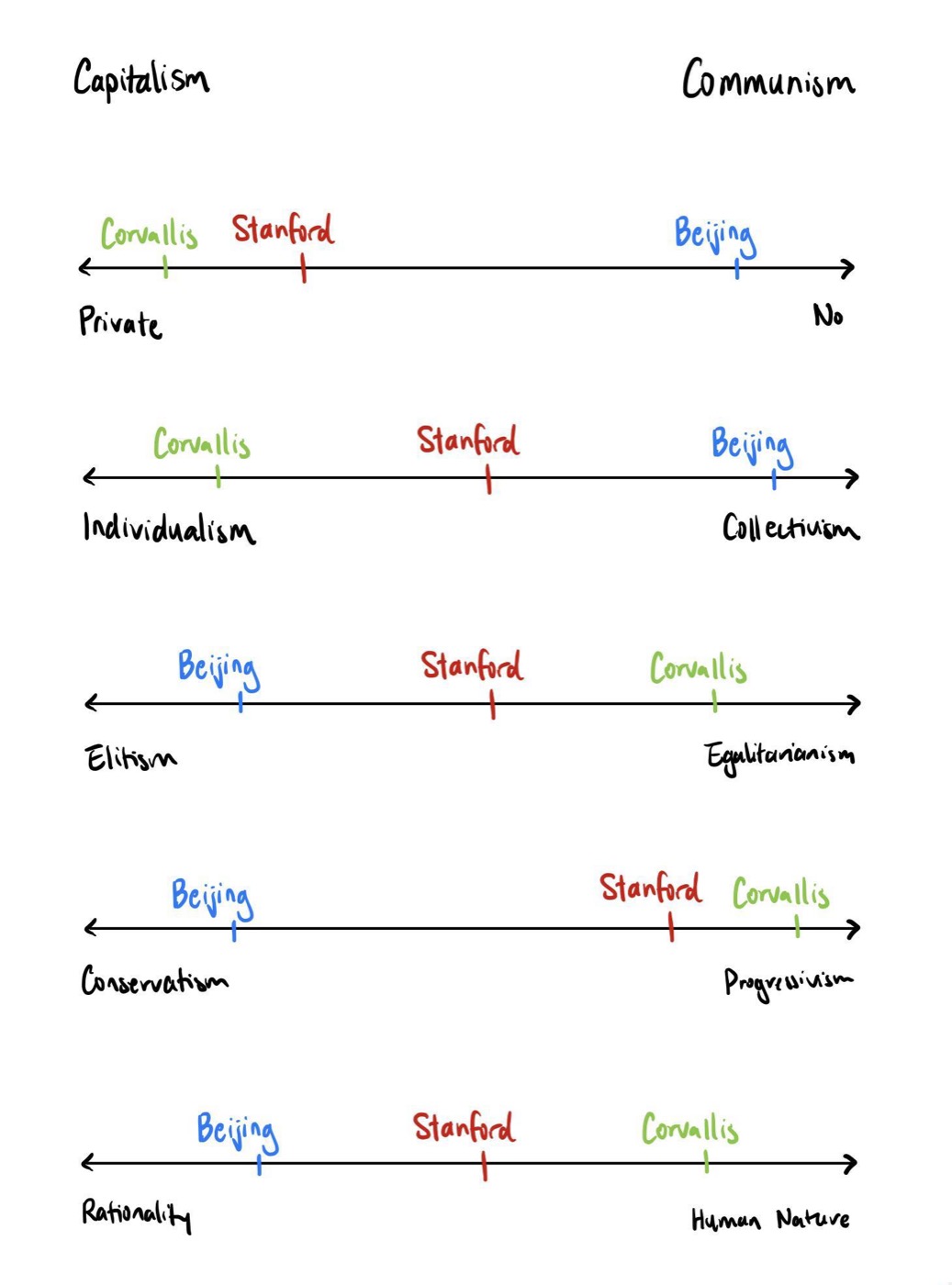
I argue that the existence of the ideal state is highly correlated with its incorporation of both modes of thought in moderation, that across each sliding scale of dual qualities, the state exhibits behavior that rests in the middle. Stanford is the ideal or best locale out of the three as it is the most desirable place to live for the most number of people. Wealth per capita and intellectual property per capital is undoubtedly the highest at Stanford than the other two locations. The university’s sub five percent acceptance rate demonstrates the general public’s desire to attend the institution and thereby live at Stanford. Real estate prices are also highest at Stanford, further suggesting the high desirability for people to live there. In addition, given the locale’s greater wealth, emphasis on fitness, and access to the world’s top medical facilities, we can theorize that the average health and wellness is also superior at Stanford over the other two locations.
Beyond purely theoretical reasoning, I gathered empirical data through an anonymous survey polling a random population on Reddit/TakeMySurvey and surveyswap.io. Gathering data through such platforms was preferred over other tools for collecting responses (e.g. email outreach), as they are the most representative of a random general population of the world. The survey contained one multiple choice question, phrased as “If you had to pick one of the following places to live, which would it be?” There was also a follow-up free response question asking “What is your reasoning for your selection above?” Out of 19 survey respondents, 11 preferred to live in Stanford, 1 preferred to live in Beijing, and 7 preferred to live in Corvallis. The rationale for those wanting to live in Stanford included “living standard” and “job prospects and opportunities for the young''. Given that the survey is in English, the population skews American, which may explain the strong aversion toward living in Beijing. The population may also skew younger, given that the respondent needed to be technologically adept to know of and access platforms like Reddit. Further, the sample size is quite small, so more sampling may be needed to validate any conclusion drawn from the data. However, preliminary survey results affirm the hypothesis that Stanford is the most desirable place to live.
Overall, through this model of thinking about the capitalist-communism complex, and particularly the comparison of the three locations across five qualitative axes, we observe a high correlation between the best state and the existence—and in particular, balance—of dual capitalist and communist ideals.
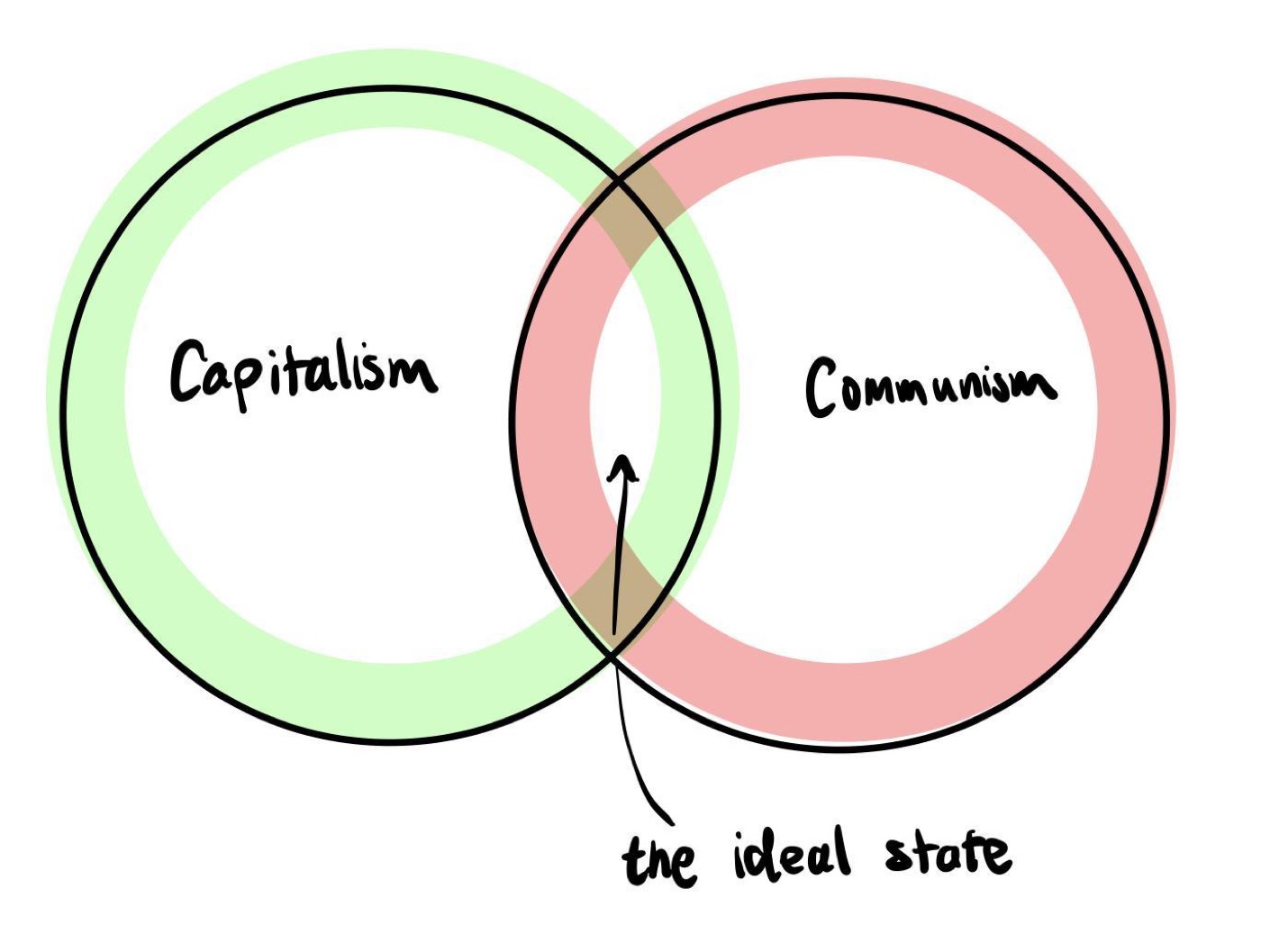 We think of capitalism and communism as polar opposites, but actually, they can coexist, and it is precisely at this coexistence that the ideal state resides.
IV. Other Considerations
It is important to consider why the ideal state exists at the intersection of capitalists and communist spirits. The model and analysis above only suggests the correlation between the ideal state and the overlap of capitalism with communism. Much thinking can be done in regards to why this may be the case.
In striving toward the perfect society, sovereign jurisdictions teeter between capitalism and communism. The Russian Revolution involved urban industrial proletarians and rural farmers removing capitalists from power in the pursuit of Communist ideals. The People’s Republic of China began under a classless, socialist sentiment, with the establishment of communes under Mao, but quickly shifted toward market-oriented economic reforms, private enterprises, and greater emphasis on competition with Deng’s leadership. Now, in the United States, we are witnessing a cultural moment of dissatisfaction with the status quo, with young Americans shifting toward a preference for socialism and away from capitalism. A recent survey showed that regardless of political affiliation, 42% of Americans ages 18-24 have positive perceptions of capitalism, while 54% hold a negative view (Gregg). In witnessing these historical ebbs and flows, it seems that arriving at the perfect society is like finding balance on a scale—when either side of capitalism or communism becomes too heavy or extreme, the people of the state want to go to the other side. In this manner, society strives to find equilibrium.
Works Cited
Arneson, Richard. “Egalitarianism.” Stanford Encyclopedia of Philosophy, Stanford University, 24 Apr. 2013, plato.stanford.edu/entries/egalitarianism/.
Chakrabarti, Meghna, and Jess Yarmosky. “Oregon Dropped Graduation Test Requirements. Here's What That Means for Education in the State.” On Point, WBUR, 24 Sept. 2021, www.wbur.org/onpoint/2021/09/24/oregon-dropped-test-requirements-what-that-means-for-the-states-testing-future.
Gregg, Samuel. “Young Americans Increasingly Prefer Socialism. Here's How to Change Their Minds.” The Heritage Foundation, www.heritage.org/progressivism/commentary/young-americans-increasingly-prefer-socialism-heres-how-change-their-minds.
Marx, Karl, and Friedrich Engels. Economic and Philosophic Manuscripts of 1844. Foreign Languages Pub. House, 1956.
Marx, Karl, et al. The Communist Manifesto. Penguin, 2002.
Marx, Karl. Capital. Dent, 1957.
Naughton, Barry. “Is China Socialist?” Journal of Economic Perspectives, vol. 31, no. 1, 2017, pp. 3–24, doi:10.1257/jep.31.1.3.
Politics & Voting in Corvallis, Oregon, www.bestplaces.net/voting/city/oregon/corvallis.
Selsky, Andrew. “Oregon 1st State to Decriminalize Possession of Hard Drugs.” PBS, Public Broadcasting Service, 1 Feb. 2021, www.pbs.org/newshour/politics/oregon-1st-state-to-decriminalize-possession-of-hard-drugs.
“Stanford Lands.” Facts, facts.stanford.edu/about/lands.
“Stanford Policies on Intellectual Property.” Office of Technology Licensing, otl.stanford.edu/stanford-policies-intellectual-property.
Weber, Max. The Protestant Ethic and the Spirit of Capitalism. Scribner's Sons, 1958.