Pick One: The Citizenship Debate of the Chinese-Indonesians, 1945-1967
History 86Q, Origins of Antisemitism, Stanford · March 2022 · PDF
Introduction
A letter my grandmother wrote to me on February 24th, 2022. In it, she describes her last conversation with the customs officer in Indonesia, in 1956, when she left her birth nation for China.
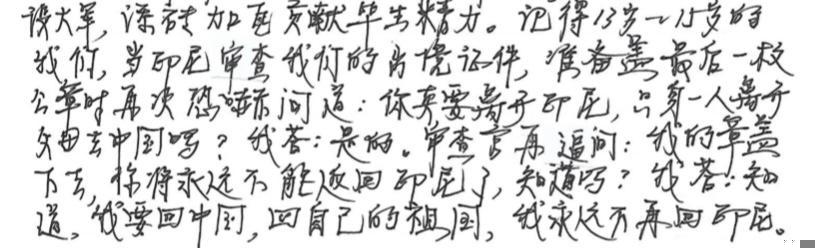
“The officer, looking at my 16-year-old self, asked me: are you sure you want to leave Indonesia, leave your parents, and travel alone to China? I answered: yes. The officer asked again: after I stamp this last stamp, you can never return to Indonesia, do you understand? I answered: yes. I am going back to China, to my motherland, I am never going back to Indonesia.”
Never having stepped foot in China, and only with distant relatives in this newly-established republic across a sea, my grandmother somehow decided that it was worth leaving behind her birth country, her parents, grandparents, and generations of ancestors before her born in Indonesia—all for the promised motherland of the People’s Republic of China. In this essay, I examine the Chinese-Indonesian minority’s attachment to the Chinese “motherland”, whether this attachment varied through different generations of Chinese-Indonesians, and when the situation arose to pick between Chinese and Indonesian citizenship, what forces dictated their choice.
The History of the Chinese in Indonesia
Long before the Dutch East India Company (VOC) colonized Indonesia in the late-seventeenth century, Chinese sojourners had become a socially visible group in the archipelagos. This population further increased amid the Qing dynasty’s expansion throughout the 18th to 20th century, during which Chinese migrants settled on the islands to escape recurring famines and pursue economic opportunities.1 The various waves of migration produced cultural distinctions among the Chinese-Indonesians. Scholars defined the Peranakans as the “local-born and acculturated Chinese” who had resided in Indonesia for centuries and adopted many elements of the indigenous culture. On the contrary, the Totoks were more recent immigrants often born in China and maintained Chinese customs to a greater extent than the Peranakans.2
By the mid-twentieth century, the Chinese-Indonesians, regardless of Peranakan-Totok identity, passively fell into a dual citizenship status. The Chinese Nationality Law of 1909 applied the principle of jus sanguinis to grant descendants of a Chinese person, regardless of birthplace, Chinese nationality.3 Thereafter, Indonesia declared independence in 1945 and passed UU No. 3 of 1946 to automatically grant Indonesian citizenship to Chinese residents “who had resided in the former colony for a minimum of five years.”4 This dual identity fueled increasing scrutiny from an Indonesian majority that considered the ethnically Chinese minority as outsiders and national security threats.5 This sentiment ultimately led to the Sino-Indonesian Treaty on Dual Nationality in 1955 and Act No. 62 of the year 1958 Concerning Republic of Indonesia Citizenship, which forced the Chinese-Indonesians to choose a single nationality, thereby either renouncing their Chinese or Indonesian citizenship.6 Presumably, this choice of nationality could orient toward an individual’s birth nation or the duration of the individual’s ancestry in Indonesia. Scholars such as Donald E. Willmott hypothesized that the Peranakans were more likely to become citizens of Indonesia because the country was the only home they had ever known.7 This train of thought theorized that emotional attachment outweighed other personal interests, and therefore, Chinese-Indonesians would pledge allegiance to the country in which they were raised. Past scholarship along this line emphasized the dominant role of the Peranakan-Totok identity in the choice of nationality. However, further historic analyses showed that the line blurred between the Peranakans and Totoks when it came to picking citizenship status. While the Peranakan-Totok identity may impact the decision, factors such as racial status, economic prospects, and place within the family unit played more significant roles during the process of choosing nationality.
The Quest for Improved Racial Status
Before Indonesia’s independence, anti-Chinese hostility brewed among the indigenous masses as a result of Dutch divide-and-rule policies.8 To prevent the already-established Chinese and indigenous populations from defying Dutch colonization, the VOC established separate quarters for the Chinese and native Indonesians, enforced a pass system to thwart travel between the segregated districts,9 and provided economic privileges to the Chinese, establishing them as revenue farmers who collected taxes from the indigenous population and returned sizable profits from the opium trade.10 The rise of Chinese economic prosperity through Dutch preferential treatment stimulated anti-Chinese antagonism. The indigenous Indonesians believed that the minority Chinese population—representing about five percent of the population yet controlling around 70–75 percent of medium and large-scale private enterprises11—stole their economic opportunities. The ethnic Chinese faced stereotypes of greed, became scapegoats for economic downturns, and experienced the proliferation of anti-Chinese violence; actions of vandalism, assault, and murder against the ethnically Chinese began during colonial times and increased exponentially in frequency after Indonesia’s independence.12 The status of the Chinese race was second-class during Dutch colonization, just below that of the Europeans; however, post-independence, as the indigenous population gained control of the government and passed new legislation, the Chinese lost protection from the Dutch, and their race became increasingly discriminated against and inferior in the social stratosphere.
In addition to negative stereotypes stemming from Dutch policies, the overseas Chinese felt their reputation tied to that of the Chinese state. In the late 18th and early 19th century, China lost considerable international power following its defeat in the Opium War, the First Sino-Japanese War, and the fall of the Qing dynasty.13 Some Chinese-Indonesians believed that the recovery and rise of the Chinese state could contribute to a better image for the Chinese minority abroad. The Totok’s reputation was inextricably linked with China—as first-generation immigrants, they were pure-blooded Chinese who often owned land or had close family in China. However, the Peranakans, who had settled in Indonesia for centuries, also found their reputation to be closely tied with that of the Chinese state. Liem Koen Hian, a Peranakan, wrote in 1919, “I have a fatherland across the sea which is trying to enhance itself… Among its own sons overseas are my people in the Indies who, in turn, look to their fatherland to enhance their status. It is the duty of the Peranakan Chinese that, before we help other countries, we should help China because we place all our hope in China.”14 Liem’s writing proved that, as a displaced minority group abroad, the Peranakan’s status in society was not distinguished from that of the Totok’s. They were both ethnically Chinese, and this racial identity ruled above all else. Liem’s familial references between his “people” and China demonstrate an emphasis on genetic relationships, showcasing how the acculturated Peranakans came to identify their standing in society with their race. With little racial affirmation in Indonesia, China was seen as a distant savior that could elevate the sense of belonging and social reputation long craved by the overseas Chinese.
While also in the pursuit of better treatment for the Chinese race, other Chinese-Indonesians—Peranakans and Totoks alike—aligned themselves with Indonesian nationalism instead. During the revolutionary war efforts, they hoped that their alliance with indigenous Indonesians would improve the chances of pro-Chinese policies following the anticipated independence. Liem, who began his career as a Chinese nationalist, changed his stance in 1925 to promote Indonesian Citizenship.15 To arrive at this new position, he reasoned that “the struggle between the Dutch and indigenous Indonesians would eventually lead to Indonesia’s independence”, and that to the Peranakan, to whom “China was a land of mystery”, it would be in their self-interest to support Indonesia’s independence and win the sympathy of the indigenous Indonesians.16
Yet, this planning for a better social standing for the Chinese race was not unique to the Peranakans, as Totoks who migrated for economic reasons hoped that they could continue to build their livelihood in their new home. For example, Wu A Gao, a Totok farmer who developed anti-Dutch sentiments due to their confiscation of his farmland, sided with the Indonesians in their fight for independence. This not only provided him an outlet to express his anti-Dutch resentment but also gave him the hope to fare better under the policies of the new nation on the horizon.17 Therefore, the quest for improved racial status spanned across Peranakans and Totoks. Although along the lines of Willmott’s theory, the factor of the Peranakan-Totok identity may influence national identification to some degree, the more critical factor in this decision was made through an evaluation of other factors like the status of the Chinese race. Across Chinese and Indonesian nationalists, the hope for improved treatment of the Chinese race underscored the decision of political affiliation, which carried into the eventual choice of nationality.
This theme continued to strengthen following the Chinese Communist Party (CCP)’s establishment of the People’s Republic of China (PRC) in 1949.18 For Liem, who continued to publicly advocate for Indonesian citizenship post-independence,19 growing conflicts between Indonesian nationalists and left-winged communists motivated him to become more public about his pro-communist opinions.20 This culminated in his arrest during an anti-communist purge in 1951 by the nationalist Sukiman government. Suffering heavily in prison, Liem renounced his Indonesian citizenship upon release and became a citizen of the PRC.21 The betrayal of the Indonesian nationalists, with whom he had sided, showed Liem that no amount of fervent support for the Indonesian government would ever allow Liem, a Peranakan, to become included and accepted. Liem later accused the Sukiman government of advocating for racial hatred and turning a blind eye to rampant racial discrimination. Ultimately, despite his Peranakan identity and sentiment that “China was a land of mystery”,22 Liem chose Chinese citizenship amid a wake-up call that post-independence Indonesia would continue to exclude his race.
The increase in anti-Chinese hostility after Indonesia’s independence opened up the opportunity for CCP propaganda—which advocated for one united China and a promise of a brighter future for the Chinese race—to appeal to Peranakans and Totoks alike seeking an ethnic home. The CCP’s ideology reached the Chinese-Indonesians through radio broadcasts from mainland China, newspaper publications such as Xin Bao and Sheng Huo Bao, and Chinese language schools.23 Such sources of media were accessible by both Peranakans and Totoks, as they often lived in the same segregated Chinese communities or Chinatowns (a tribute to the lasting impact of Dutch policies).24 Huang Huilan, who was born in Indonesia and eventually left for her Chinese motherland, was well-versed in Cultural Revolution propaganda texts while growing up; she knew the song, “Sailing the Seas Depends on the Helmsman,” which included lyrics like “Mao Zedong and revolution depends on the thought of Mao Zedong.”25 These lyrics were also translated into Indonesian and became widely circulated,26 all to show the extent to which Chinese-Indonesians became familiarized with CCP ideologies.27
The Divisive Effects of Indonesia’s Economic Policies
Despite racial prejudices in Indonesia and a welcoming ethnic home in China, many Chinese-Indonesians still ultimately chose Indonesian citizenship.28 This choice can be attributed to a concurrent evaluation of economic prospects during their decision-making process. Legislation like Presidential Decree No. 10 aimed to reduce the economic role of the ethnic Chinese, but ultimately forced a divisive response of mass assimilation or mass exodus. In the Presidential Decree No. 10, “alien” retail trade was banned in rural areas, and businesses owned by “aliens” must be transferred to Indonesian citizens by January 1, 1960.29 In this case, “alien” included those who held citizenship of another country, such as Chinese-Indonesians who had yet to renounce their Chinese citizenship. The Presidential Decree No. 10 resulted in the loss of many Chinese-owned businesses and caused an estimated 136,000 Chinese to repatriate.30 Similar anti-Chinese economic policies drove farmers and small business owners, often Totoks with relatively more connections to China, to repatriate. On the other hand, Peranakans who were wary of rebuilding their livelihood in a foreign country, culture, and sometimes even a foreign language, chose Indonesian citizenship in order to continue operating their businesses and sustaining their economic livelihood.
Some very successful Totok merchants felt this economic pressure to renounce their Chinese citizenship as well. For Bai Fu Rong, a Totok merchant with a successful business, choosing Chinese citizenship would mean the end to his prominent career.31 Therefore, Totoks like him would renounce their Chinese citizenship and opt for an Indonesian one in order to continue the legacy of their business. From Indonesia, he financially supported his family, of which all members but him chose to repatriate.32 In doing so, he had to compromise his true Totok Chinese identity by assimilating to Indonesian culture and political demands33—he married a second wife, who was fully Indonesian, and visited China only once more during his lifetime in secrecy.34 As a result, his Indonesian citizenship status was not truly a voluntary one, but rather a coerced one. This theme rings true for many Peranakans choosing Indonesian nationality as well; in describing the Indonesian citizenship status of Kwee Bek Beng, Suryadinata depicted how Beng’s choice was not one he fully embraced, but rather one of lesser evils,35 and in Willmott’s analysis, Peranakans who chose Indonesian citizenship “would have liked to ‘see’ China again, or even to die there.”36
Family, Finances, and Futures
The motivations for improved racial status and sustained financial bottom lines were not the only factors weighing above the Peranakan-Totok identity. Academic discourse and discussions with the overseas Chinese pointed toward a distinct trend of teenagers repatriating to China. Zhou estimated that between the early 1950s and early 1960s, around 60,000 ethnic Chinese students in Indonesia left for the PRC, and that by the late 1960s, at least 164,000 ethnic Chinese had “returned” to their ancestral homeland even though most of them were born and raised in Indonesia.37 This statistic implies that roughly one-third of Chinese-Indonesians who repatriated were still in school when they left Indonesia for China. Anecdotal evidence verifies that many in the community of repatriated Chinese-Indonesians were only teenagers when they chose Chinese citizenship.38
The reason for this trend could be explained through multiple angles. The most obvious was that the elderly found it more challenging to move and adjust to new environments, whereas the youth was more willing to adventure and adapt. In addition, teenagers oftentimes possessed a natural desire to leave their parents’ home, and the pursuit of higher education was a precedented reason to relocate. Furthermore, educational institutions, especially boarding schools, which many repatriated Chinese-Indonesian teenagers attended, created an easy opportunity to find a sense of community amid a new environment.
However, the possibility for assessments of racial status and economic prospects to produce a clashing conclusion leads to the most compelling explanation for why teenagers chose to repatriate at higher rates during this time. For almost all Chinese-Indonesian families, the factor of racial status would lean them toward relocating to China, while in some cases, economic prospects would point them toward staying in Indonesia. Even for those whose economic prospects shined brighter in China, it was risky for an entire family to completely remove all ties from their established homes and settle into a new life abroad. As a family unit, in order to both pursue a more accepting social environment and sustain a stable financial bottom line, the most compelling plan was for teenagers, after graduating from middle school or reaching an age of maturity to live alone, to move to China first to attend an overseas boarding school (often in the case of Peranakans) or to live with distant relatives (more likely in the case of Totoks). Meanwhile, the mother would stay to raise any remaining children, while the father would continue making a living in Indonesia to support the family and children abroad. Eventually, the mother would move after all or most of the children have left Indonesia, and the father would be the last to repatriate, if at all.39 Therefore, in the cases where evaluations of racial status and economic prospects led to an inconclusive determination, the family unit would choose to split in order to attain the best of both worlds—the promise of a more accepting community with improved social status, as well as the continuation of a strong financial grounding. Oftentimes, the ability to live in a country more accepting of the Chinese race was prioritized for the children of the family, while the responsibility to continue providing economic support rested upon the father. This element of determining citizenship status applies to any scenario where an unclear best option existed for a family, and thus it transcended the factor of the Peranakan-Totok identity.40
Conclusion
The Peranakan-Totok identity may have set predetermined restrictions (such as cultural and language barriers), but ultimately, during the citizenship debate, the Chinese-Indonesians considered most critically the factors of racial status, economic prospects, and role within the family structure. Oftentimes, this choice was not a wholly voluntary or embraced one, and some, such as Liem, exhibited changing opinions throughout their lifetime, meaning that their choice reflected only a temporal sentiment. The Chinese-Indonesians who chose Indonesian citizenship would face decades more of anti-Chinese hostility, violence, and massacre. Through it all, they would assimilate out of self-protection and government decree. Those who left were greeted with a new beginning in a republic during its infancy. While they may have been primarily attracted to China for the CCP’s political promises and the long-awaited attainment of a sense of ethnic belonging, they still faced the growing pains of a developing nation.
The story of the Chinese-Indonesians echoes the repeated pattern of a dispersed ethnic minority seeking the promise of an ancestral homeland. After being deprived of racial acceptance for so long, it seemed that no matter how many generations prior their ancestors sojourned to a foreign land, they would forever be perceived as and feel alien within their host nation. In the case of my grandmother, the Indonesian attachment toward her Peranakan identity did not hold her back, but rather, the Chinese promise of her Peranakan upbringing guided her to search for a better life in a land that was at once foreign yet kin.
Notes
-
Alexander Claver, Dutch Commerce and Chinese Merchants in Java: Colonial Relationships in Trade and Finance, 1800-1942 (Boston: Brill, 2014), 135-6. ↩
-
Wu-Ling Chong, Chinese Indonesians in Post-Suharto Indonesia: Democratisation and Ethnic Minorities, (Baltimore: Project Muse, 2019), 32. ↩
-
Elizabeth Chandra, “‘We the (Chinese) People’: Revisiting the 1945 Constitutional Debate on Citizenship,” Indonesia, no. 94 (2012): pp. 85-110, 90. ↩
-
Ibid. ↩
-
Ibid. It is important to note that the Chinese were culturally, racially, and economically distinct from the indigenous population during this time. ↩
-
The agreement to terminate dual citizenship was made in the 1955 treaty. It was formally implemented into law in 1958; See Chandra, “‘We the (Chinese) People’: Revisiting the 1945 Constitutional Debate on Citizenship,” 90. ↩
-
Donald Earl Willmott, The National Status of the Chinese in Indonesia (Ithaca, NY: Modern Indonesia Project, Southeast Asia Program, Dept. of Far Eastern Studies, Cornell University, 1956), 96. ↩
-
Chong, Chinese Indonesians in Post-Suharto Indonesia: Democratisation and Ethnic Minorities, 26. ↩
-
Ibid, 26-7. ↩
-
James R. Rush, “Social Control and Influence in Nineteenth Century Indonesia: Opium Farms and the Chinese of Java,” Indonesia 35 (1983): p. 53-64, 55. ↩
-
Juliette Koning, “Chineseness and Chinese Indonesian Business Practices: A Generational and Discursive Enquiry,” East Asia 24, no. 2 (2007): 129-152, 133. ↩
-
Chandra, “‘We the (Chinese) People’: Revisiting the 1945 Constitutional Debate on Citizenship,” 104. ↩
-
Chong, Chinese Indonesians in Post-Suharto Indonesia: Democratisation and Ethnic Minorities, 27-8. ↩
-
Leo Suryadinata, Peranakan's Search for National Identity: Biographical Studies of Seven Indonesian Chinese, (Marshall Cavendish Academic: 2004), 68. ↩
-
Suryadinata, Peranakan's Search for National Identity: Biographical Studies of Seven Indonesian Chinese, 69. ↩
-
Ibid, 70. ↩
-
Lin Xueming, email message to author, February 24, 2022. Wu was Lin’s friend’s father. While his family name was Wu, “A Gao” was his nickname. His legal name is not revealed for confidentiality. ↩
-
Suryadinata, Peranakan's Search for National Identity: Biographical Studies of Seven Indonesian Chinese, 85. ↩
-
Exhibited by his statement in the Naskah Persiapan Undang-Undang Dasa (the Preparatory Manuscript of the Constitution) in 1945. ↩
-
Liem’s communist leanings grew more obvious after the Madiun affair, an armed conflict between Indonesian nationalists and the left-leaning groups, which led to the arrest of pro-communist leaders; see Suryadinata, Peranakan's Search for National Identity: Biographical Studies of Seven Indonesian Chinese, 83). ↩
-
Suryadinata, Peranakan's Search for National Identity: Biographical Studies of Seven Indonesian Chinese, 86. ↩
-
Ibid, 70. ↩
-
Lin Xueming, email message to author, February 24, 2022. ↩
-
Ibid. ↩
-
Taomo Zhou, Migration in the Time of Revolution China, Indonesia, and the Cold War (Ithaca, NY: Cornell University Press, 2019), 136. ↩
-
Ibid. ↩
-
The spread of Chinese cultures and political ideologies ended in 1967 with the Suharto regime. Hence, this paper examines the period after Indonesia’s independence until 1967, when the question of nationality was most intensely debated. ↩
-
No specific statistics can be provided here in replacement of the word choice “many”, as different sources published different statistics that reflect their own bias. For example, the Consultative Body for Indonesian Citizenship concluded that less than 10 percent of Indonesians chose Chinese citizenship, while Peking estimated that the majority of Chinese-Indonesians chose Chinese citizenship; see Chandra, “‘We the (Chinese) People’: Revisiting the 1945 Constitutional Debate on Citizenship,” 10. ↩
-
Chong, Chinese Indonesians in Post-Suharto Indonesia: Democratisation and Ethnic Minorities, 31. ↩
-
Benny G. Setiono, Tionghoa Dalam Pusaran Politik (TransMedia: 2008), 795. ↩
-
Lin Xueming, email message to author, February 24, 2022. ↩
-
Ibid. ↩
-
Such efforts to assimilate dramatically deepened post-1967, when the Suharto regime banned all Chinese media, language schools, and culture in an effort to erase the Chinese identities of the ethnically Chinese Indonesians. ↩
-
Lin Xueming, email message to author, February 24, 2022. ↩
-
Suryadinata, Peranakan's Search for National Identity: Biographical Studies of Seven Indonesian Chinese, 109. ↩
-
Willmott, The National Status of the Chinese in Indonesia, 65. ↩
-
Echoing the sentiment expressed in footnote 28, statistics published during this time should only be taken as a rough estimate of the landscape. ↩
-
Lin Xueming, email message to author, February 24, 2022. Repatriation or moving to China is highly correlated with choosing Chinese citizenship. In almost all cases, those who stayed in Indonesia would become Indonesian citizens (for better protection from the government), and those who left for China would become Chinese citizens. ↩
-
Lin Xueming, email message to author, February 24, 2022. ↩
-
One could argue that teenagers who repatriated were more likely to be Indonesia-born Peranakans; due to their young age, it was unlikely that they were first-generation immigrants to Indonesia, then migrated back to China. However, this still counters scholarship aligned with Willmott’s idea noted on pg. 3—that Peranakans who grew up in Indonesia would be more likely to remain emotionally attached and thus remain in their birth country, and that the factor of birthplace or Peranakan-Totok identity played the dominant role during the citizenship debate. ↩
Bibliography
Chandra, Elizabeth. “‘We the (Chinese) People’: Revisiting the 1945 Constitutional Debate on Citizenship.” Indonesia, no. 94 (2012): 85–110. https://doi.org/10.5728/indonesia.94.0085.
Chong, Wu-Ling. Chinese Indonesians in Post-Suharto Indonesia: Democratisation and Ethnic Minorities. Baltimore, MD: Project Muse, 2019.
Claver, Alexander. Dutch Commerce and Chinese Merchants in Java: Colonial Relationships in Trade and Finance, 1800-1942. Boston, Massachusetts: Brill, 2014.
Koning, Juliette. “Chineseness and Chinese Indonesian Business Practices: A Generational and Discursive Enquiry.” East Asia 24, no. 2 (2007): 129–52. https://doi.org/10.1007/s12140-007-9011-2.
Rush, James R. “Social Control and Influence in Nineteenth Century Indonesia: Opium Farms and the Chinese of Java.” Indonesia 35 (1983): 53. https://doi.org/10.2307/3350865.
Setiono, Benny G. Tionghoa Dalam Pusaran Politik. TransMedia, 2008.
“Sin Po.” The Library of Congress. Accessed February 27, 2022. https://www.loc.gov/item/sn94048302/.
Suryadinata, Leo. Peranakan's Search for National Identity: Biographical Studies of Seven Indonesian Chinese. Marshall Cavendish Academic, 2004.
Willmott, Donald Earl. The National Status of the Chinese in Indonesia. Ithaca, NY: Modern Indonesia Project, Southeast Asia Program, Dept. of Far Eastern Studies, Cornell University, 1956.
Zhou, Taomo. Migration in the Time of Revolution: China, Indonesia, and the Cold War. Ithaca, NY: Cornell University Press, 2019.