At The Speed of Mission: Recommendations on Innovation in Technology Contracting & Acquisition
INTL 340, Technology, Innovation and Great Power Competition, Stanford, with Jonah Cader, Sophie Fujiwara, Grant Gordon and Spencer Gore · December 2022 · PDF
I. Executive Summary
As the United States and the People’s Republic of China (PRC) compete for technological supremacy, the ability to translate commercial and academic innovation to defense and national security use cases is key. China has embarked on a whole-of-nation approach to this conflict via Military-Civil Fusion (MCF), the Chinese Communist Party (CCP) doctrine of forced technology transfer to military applications and sweeping industrial policies such as Made in China 2025.1 The groundwork of the CCP approach is a vast science and technology complex, reorganized under the close control of President Xi Jinping.2 On top of this infrastructure, China is able to absorb technologies faster through MCF and the tight integration of state-owned enterprises (SOEs) and bring large pools of capital to bear against priority innovation pillars through government guidance funds.3
Against this backdrop, the United States Department of Defense (DoD) is struggling to effectively modernize its technology and supporting acquisition processes at the speed of mission. At one end of this problem, U.S. federal government research and development (R&D) spending has fallen to 0.7% of GDP, a concerning one third of Cold War investment levels.4 At the other end of the problem, American power projection in the Indo-Pacific remains centered on expensive, exquisite technology platforms, ill-equipped for a modern day conflict with the PRC.5 In the middle lie ossified funding allocation mechanisms, and contracting processes. These drive a disconnect between DoD strategy and execution outside of times of crisis, exacerbated by the current incentives of procurement officers and the economics of prime contacts.
This briefing outlines recommendations to heighten the competitive posture of the United States by rethinking how the DoD funds and acquires critical technologies. These insights were synthesized from 10 weeks of primary and secondary secondary research, including over 30 interviews with government officials, venture capitalists, and entrepreneurs.
Ultimately we believe that the solution may lie in appropriating an alternative funding pool for the near-term delivery of key technologies, leveraging both debt and equity vehicles in partnership with private capital. This recommendation has three component parts. First, establish a separate pool of capital through creative mechanisms such as the Defense Production Act (DPA) Title III to be deployed in parallel to existing processes. Second, rethink Small Business Innovation Research (SBIR) grants, reshaping the program to provide fewer, larger checks, capable of providing meaningful recurring revenue to earlier stage technologies. Finally, establish alternative growth financing vehicles to help accelerate more mature products through the “valley of death” with inventive investment backstops and loans. The future direction of this work will likely involve building the proposed framework into an operational plan, complete with the administrative and logistical details of how to push and then administer these changes.
The following report provides relevant context and elaborates on our key insights and recommendations.
II. The Problem
Core Problem Statement
Through an iterative fact-finding process that included 32 interviews with public and private sector stakeholders we distilled the following problem statement. This question ultimately guided the research agenda and recommendations of this report.
How can the U.S. DoD deploy alternative funding mechanisms in parallel to traditional procurement vehicles to enable and incentivize the delivery of critical next-generation technology in under 5 years?
Problem Formation
This project’s story began at the fall 2022 Defense Investor Network (DIN) Conference in Menlo Park, California. As members of our team engaged across sessions with DoD innovation units and private sector investors, a clear and troubling theme emerged: Amidst technological competition with China, the United States is struggling to match pace with the PRC’s speed of technological development and acquisition. At the outset, our team believed this to be an issue of the acquisition and contracting vehicles themselves. Our initial problem statement asked: “How can the U.S. DoD match or beat the speed of great power competitors in acquiring and integrating critical technologies?”
This area of inquiry spoke to our team members for two primary reasons:
-
Personal experience with a challenging defense acquisition process: One of this study’s authors, Spencer Gore founded Impossible Aerospace (IA) in 2016 to commercialize domestically made Unmanned Aerial Systems (UAS). The company incorporated unique battery technology to approximately double the flight time of surveillance drones. As a technical founder without a defense network, Gore was at a loss as to how to sell into the Department of Defense. On an investor’s recommendation, the company hired a consultant to apply for a USAF Phase I Open Topic SBIR. After the company was awarded a Phase II SBIR, Gore assumed that it was well on its way to transitioning its technology onto a contract. IA was ultimately invited by the Defense Innovation Unit (DIU) to apply for the Blue UAS 2.0 Program, which sought to onboard a variety of small UAS onto the GSA list. Among the key requirements for this unfunded opportunity was to re-engineer the production aircraft to comply with new supply chain requirements, which prohibited essentially all Chinese content. The costs involved in doing so would mean IA’s aircraft could never again be commercially viable. Unable to raise further money without a clear pathway to further contract revenue, the company quietly sold for a small sum to a publicly-traded conglomerate which largely put its technology on the back burner.
-
Pattern recognition from vantage points in venture capital: The majority of this study’s authors have worked across the venture and growth capital ecosystems, some explicitly focusing on companies in the defense and national security technology space. They have seen firsthand the challenges that promising new technologies face trying to break into the DoD procurement process and ecosystem.
Over the course of the effort, the team’s mandate evolved from a narrow focus on contracting vehicles to a more expansive exploration of the capital pools behind these tools. We ultimately realized that the
problem is upstream of the procurement vehicles. Instead, it lies with the appropriated money that both supports novel technologies through the precarious period prior to winning a program of record and that funds these vehicles. Our research and journey reflects this evolution of understanding.
III. Background & Research
The Venture Capital (VC) Ecosystem
What venture capitalists look for: Venture capital specializes in high-risk high-return investments. A typical deal may involve a venture capital fund investing $3 million in exchange for 40% equity in an early-stage startup. On average, venture capitalists expect a 10-15 times return over a fund life of about 7-10 years.6 To do so, VCs prefer investments in industries with high growth rates and a large total addressable market. VC-fundable companies typically have a quick roadmap to recurring revenue and hold the potential to generate billion-dollar returns. In recent decades, software companies have overwhelmingly fit the appetite of venture capitalists due to their high margins, rapid scalability, and quick development to deployment turnaround.
Venture capitalists aim for outsized potential returns. According to venture capitalist Chris Dixon, VCs are not looking to make ten investments that all return a small positive multiple. Rather, they are looking to make ten investments where one has the potential to be a “home run”, which “for good funds are around 20x, but for great funds are almost 70x.”7 As such, the other nine investments do not need to return any money for the fund as a whole to generate a 10-15 times return. In other words, venture funds follow a power law distribution, where only ~20% of investments will account for ~80% of the value.8
Funding of defense technology: Historically, defense technologies have not fit the ideal profile for a venture-backable company. According to venture investor Katherine Boyle, many defense innovations rely on hardware, which requires large upfront capital while producing lower margins.9 In comparison, software companies have “80 percent margins”, are easier to scale, and do not require as much capital.10 Therefore, for the majority of venture capitalists, investing in software over hardware companies simply makes more sense.
In addition, it is difficult for defense companies to meet the recurring revenue figures that investors would like to see. Many companies may receive SBIRs early on, but the one-time nature of such grants are not indicative of future contracts. Government contracts also operate over long timelines, which slows the process toward revenue. As a result, many defense startups
face the “Valley of Death”, the phase after a startup has launched a product, but before any recurring revenue occurs.11
Unfortunately, out of the $857 billion US national-security budget for 2022, only $34 billion, or approximately 4%, was allocated toward defense innovation.12 This means that defense contracts are competitive and do not offer the revenue required to achieve a market capitalization that suits the appetite of venture capitalists.
Even for defense companies that have produced positive returns, it is rare for such sums to be outsized at the level that venture capitalists define as wins. For example, Blackbird Technologies was acquired by Raytheon, a defense prime, for $420 million.13 While this may seem like a positive outcome, “for large, Silicon Valley tier-one funds, it doesn’t move the needle.”14 This further highlights how only multibillion-dollar opportunities make economic sense for venture capitalists, and few defense companies have traditionally met that expectation.
Disruptors in Defense Tech: A New Template or Improbable Success?
Despite this, there have been some successful venture-backed defense tech companies.
Anduril: Most government contractors are reliant on SBIRs and other sources of funding, meaning they have to build for government specifications in order to make enough revenue to stay alive. Anduril began as a well-funded, venture-backed company with founders Palmer Luckey, the founder of Oculus which exited to Facebook for $2B, Trae Stephens of Palantir and Founders Fund, and Brain Schimpf, Palantir’s engineering lead15. This allowed Anduril to build for what the DoD needed, not what it was asking for. Traditionally, the DoD has tended towards hardware products, but Anduril focused on building the software needed to keep their hardware competitive. They specialized in cutting-edge technologies like computer vision, AI/ML and edge computing which the government did not ask for of their own accord, instead making Anduril sell into the DoD by showing how mission-critical their products like Lattice OS were in productively harnessing data across all terrains, sensory inputs, and forces.
Palantir: Palantir was founded 14 years before Anduril, in 2003. It struggled to raise venture funding from anyone in the Valley, ending up almost completely funded by Peter Thiel, its billionaire founder, and a small check from In-Q-Tel, a government VC arm. Palantir has since raised $3B over multiple funding rounds, including an IPO at a $22B valuation in 2020. They have set the stage for many other defense companies to be backed, often by Thiel’s Founders Fund, by posting $1.5B in revenue.16 However, they
are still an unprofitable company, showing the timeline and deep pockets needed for a venture-backed defense company to succeed, given the high costs of R&D and talent retention.
SpaceX: SpaceX has beat the odds time and time again, now becoming a respected and dominant player in space access. Elon Musk bootstrapped the company, staying extremely frugal and ignoring all industry norms through in-house manufacturing and acquisition of off the shelf parts. However, space contracting was dominated by Boeing and Lockheed Martin, and their relationships with the DoD meant SpaceX had to threaten to sue in order to win its first contract17. From then on, SpaceX has been able to prove itself, raising $10B18 and successfully completing 181 launches as of November 2022.19 The success of SpaceX is summed up well by this cost analysis of Falcon 9: NASA’s estimate for in-house production is $4B or $1.7B with commercial help. SpaceX estimated its costs to be $300M, which NASA could not fathom.20
These three companies have raised over $15B in the last two decades with valuations totalling $150B, showing how defense tech is beginning to reach venture capital-sized returns. However, Palantir and SpaceX were mostly privately backed by their founders, a model that is hard to replicate due to the scarcity of billionaire backers. The problem goes beyond just the amount of funding, to the number of companies funded early-stage. As they have set precedent, it has become easier for companies like Anduril to raise from VCs as VCs can now pattern-match with this model. Despite this, many VCs are still hesitant about how many Andurils, Palantirs, or SpaceXs there will ever be, since the route for experienced founders that can build what the government needs, not what it wants, will only be replicable so many times.
Contracting Vehicles & Authorities
The Defense Acquisition Process
Procuring a weapons system involves three approximately sequential processes: Joint Capabilities Integration and Development System (JCIDS), Planning, Programming, Budgeting and Execution (PPBE), and the Defense Acquisition System (DAS). Broadly, the capability requirements identified by JCIDS are incorporated into budgetary plans by the PPBE, and when congressional funds are appropriated for the priorities it selects for programs, Program Executive Offices use the DAS to solicit proposals and award contracts for their implementation.
Identification of Requirements (JCIDS): The Joint Capabilities Integration and Development System is the process by which DoD “identifies, assesses, and prioritizes what capabilities the military needs to fulfill its mission”.21 During this process, the Joint Requirements Oversight Council (JROC) identifies unmet capability needs of the warfighter based on changes in doctrine, strategy, or global threats. They
then weigh the merits of competing materiel and non-materiel gap resolutions. The JROC’s deliverable in this phase is a recommendation to the Chairman of the Joint Chiefs of Staff, who then submits his own to the Secretary of Defense. The Secretary of Defense has final authority on the budget proposals ultimately delivered to the President, and subsequently to Congress.
Planning, Programming, Budgeting and Execution (PPBE): The PPBE is an annual process which culminates in the President’s defense budget request which is submitted to Congress. Each budget request is the culmination of five years of prior work.22
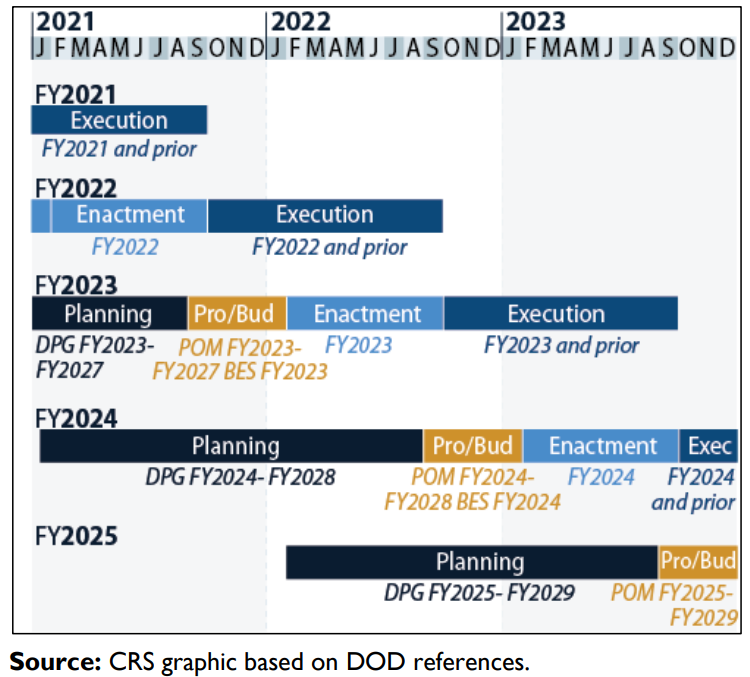 Source: CRS graphic based on DoD references.23
The four sequential components of this process are as follows:
-
Planning Phase: The Planning phase is led by the USD Policy and begins after the issuance of the National Security Strategy (NSS). During this phase, the NSS, National Military Strategy, and Defense Strategic Guidance are holistically reviewed and synthesized into a set of priorities for new programs. The outcome of this process is a secret-classified document called Defense Planning Guidance.
-
Programming Phase: During programming, the Defense Planning Guidance is translated into a set of program objectives crafted by each military component in several “Program Objective Memoranda”. These memoranda forecast the forces, personnel, and funds required to deliver on the priorities established during planning, and look five years into the future. The scope of these programs is constrained by a budget provided by OSD.
-
Budgeting Phase: During Budgeting, the DoD Comptroller leads components to complete a Budget Estimate Submission. Programs are evaluated for proper pricing, budget controls, and phasing. The Office of Management of Budget usually receives a final product in December for inclusion with the President’s annual budget request for Congress.
-
Execution Phase: The execution phase of PPBE is mostly about execution review, in which the OSD evaluates the expenditure of funds and program results. Reviewers recommend any changes to the Joint Staff.
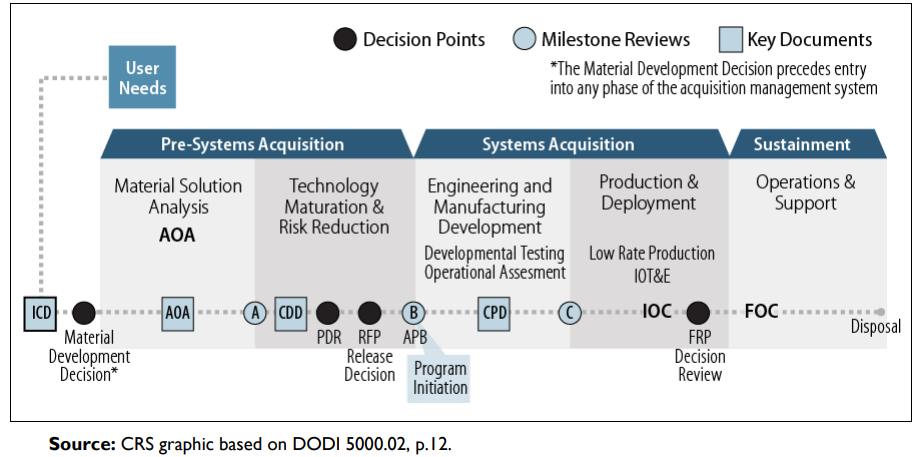 Phase 3: Defense Acquisition System. Source: CRS graphic based on DODI 5000.02, p.12.
The Defense Acquisition System is a common pipeline for all programs of record. To become a program of record, a program must:
-
Have validated and approved requirements
-
Have full funding for the length of the program
-
Have a completed independent cost estimate
-
Mitigate all sources of risk – cost, technology development, integration and sustainment – sufficiently to justify the program
Programs of record are funded and overseen by program executive offices, which can work alongside contracting offices to solicit, negotiate, award, and administer contracts against the provisioned funding.
Contracting and Federal Acquisition Regulations (FARs)
Contracts issued by the federal government must comply with the Federal Acquisition Regulations (FARs), a set of rules governing acquisition, contracts, competition, and compliance with a wide range of statutes. The authority of the executive branch to create and enforce acquisition regulations is granted in 40 U.S.C. 121(c), 10 U.S.C. chapter 137, and 51 U.S.C. 20113, which provide--among other things--that the President shall prescribe “regulations that the Administrator considers necessary” for federal procurement. The FARs today are fifty-three parts of federal regulations in 48 CFR Chapter 1.
The FARs as outlined in 48 CFR lead to administrative lead times measured in years, and are generally seen as too cumbersome and inflexible to effectively engage small businesses. For this reason, a recent trend in defense procurement has been the embrace of Other Transaction Authorities.
Other Transaction Authority (OTA)
Section 815 of the 2016 National Defense Authorization Act codified the ability of the Department of Defense to engage in prototype projects using “Other Transactions” not affected by the FAR’s. This authority is now enshrined in 10 U.S.C. §2371b, which provides the authority to “carry out prototype projects that are directly relevant to enhancing the mission effectiveness of military personnel” through prototype projects. This authority is granted to the Director of DARPA, the Secretary of all military departments, and any other official designated by the Secretary of Defense.
To issue an Other Transaction, 10 U.S.C. §2371b requires that at least one participant in the prototype effort be a nontraditional defense contractor, and that all parties in the transaction be small businesses or nontraditional defense contractors. At least one third of the total cost of the effort also must be paid out of funds from sources other than the Federal Government.
10 U.S.C. §2371b (a)(2) provides authority for contracts up to and exceeding $250,000,000 to be issued provided that the contract is essential for national security, and that the Under Secretary of Defense for Acquisition, Technology and Logistics determines in writing that exceptional circumstances justify the use of the transaction.
Other Transaction Authority does not provide funding. It is a vehicle which can be used, in certain circumstances, to issue transactions against existing program funds. For example, the Army’s Short Range Reconnaissance program funds were used to issue a Firm-Fixed-Price Five Year Production Other Transaction Agreement for $99.8 million to Skydio, a Bay Area-based small UAS manufacturer. In this case, OTA was used to hasten the award of a contract, but the contractor still had to wait for the creation of a Program of Record to fund the vehicle.
Overseas Contingency Operations (OCO)
As discussed above, the PPBE process regularly takes five years from requirements identification to budget enactment. This means that newly emergent threats or requirements cannot be addressed without a flexible side pool of capital. Following the September 11th terrorist attacks, Congress appropriated a separate pool of funds for Overseas Contingency Operations--often called war funds--to be used for emergency overseas operations. Since that time, OCO funds have been used for non-war activities.24 From FY2001 through FY2019, OCO provided 17% of the Department of Defense’s total discretionary budget.
Title 10, Section 101 of the US Code defines a contingency operation as any SECDEF-designated operation in which “members of the armed forces are or may become involved in military actions, operations, or hostilities against any enemy of the United States or against an opposing military force.”
This broad definition provides considerable flexibility in the allocation of OCO funding. For example, Operation Noble Eagle received $27.9 billion in OCO funding during peak war years for enhanced security at domestic military bases. In general, while OCO funding still must be appropriated by congress, we believe an innovation-focused capital pool might be used to issue contracts against rapidly emerging threats or to support rapidly emerging technologies for which the traditional PPBE and baseline budgeting process is inadequate.
The Defense Production Act (DPA) Title III
The Defense Production Act of 1950, as amended (50 U.S.C. App. § 2061 et seq.) provides extensive authority for the President to ensure the availability of domestic resources for national defense through the use of targeted purchases, loans, or loan guarantees. In practice, there is not yet a mechanism in place to issue loans or guarantees, and so the purchase mechanism is the main implementation vehicle.25 DPA Title III purchases are made using the congressionally appropriated Defense Production Act Fund. In 2020, DPA Title III was used to award seven contracts for the production of ventilators during the COVID-19 pandemic. More recently, it was used by the Biden administration to accelerate domestic production of key clean energy technologies.26 This authority may be used to provide financial support to domestic production of resources, materials, or technologies considered essential to national defense. It might be seen as an ideal vehicle to support the repatriation of dual-use technologies such as semiconductors, batteries, or drones.
Office of Strategic Capital (OSC)
On December 1st, 2022, the DoD announced the creation of the Office of Strategic Capital (OSC). The new office was designed to offer alternative capital sources to companies developing technology deemed critical to U.S. national security. These technologies include advanced materials, next-generation biotechnology, and quantum science. The OSC aims to fill a gap in DoD funding for technologies critical
to future DoD acquisitions but not themselves purchasable under existing procurement mechanisms.27 While few details are known about the OSC’s intended programs, it is exploring non-acquisition financial structures including loans and loan guarantees, public-private investments, and pre-product investments. These structures mirror the initial DARPA investments in fundamental research that led to Silicon Valley’s advances in computation and microchips, as well as companies including Apple, Sun Microsystems, and Cray Research. Alongside capital allocation, the OSC is empowered to use policy, coordination and research channels to counter actions by competitors that leverage US financial markets for national security advantage.28
Research Methodology
Four Phase Journey: The team used 32 interviews along with weekly Office Hours with the teaching staff to refine our problem statement. Those interviews covered a wide variety of stakeholders from venture capital, DoD acquisitions, service branches, primes, and defense startups. Our work roughly followed four phases as we incorporated expert feedback into our evolving understanding of the problem space. The first phase, focused on our original problem formation, emphasized stakeholders in DoD acquisitions and funding. Several sources identified the difficulty for startups of finding a DoD champion as a significant stumbling block. Others identified the individuals within DoD acquisitions roles as unnecessarily risk-averse and ill-equipped to mobilize the vehicle available. The feedback conflicted with the perspective of startup founders and investors, who considered the DoD acquisition process structurally insufficient. They directed our attention to the stakeholders on the private side as more realistic targets for intervention, including venture capital and public-private investors, who comprised the second phase of our journey. From these interviews the team developed an awareness of the broken acquisition system but also a counter-narrative eagerness by generalist venture capitalists to invest in defense. Traditional venture-style outcomes are difficult, but there are great companies to be built. On the flip side, startups disabused the team of our hope that Palantir, Anduril, and SpaceX had developed a repeatable playbook to sell into the DoD. Each company charted a unique, irreplicable path. Either the DoD would need to change its acquisitions process soon or startups would require a different capital structure to survive the journey. At this point, the team knew enough problems to fix, but lacked conviction about which to prioritize. We decided to splinter the third phase of our research into three sub-teams, which explored the possible misalignment of program manager incentives, the role of primes in incorporating startups, and a concrete case study on irregular forces integration suggested by a high-level source. Again, all potential problems bore fruit. Ultimately, the team found a through-line with the need for creative capital structures to help companies cross the Valley of Death. From this we produced a series of recommendations that leverage research on program manager incentives, startup needs, venture capital return requirements, and mission-aligned development of critical technologies. Our final phase of research pressure-tested these recommendations with key stakeholders, leading to the plan outlined later in this report.
Key Insights
From our research the team distilled six key insights:
-
The breakout success of Anduril, SpaceX, and Palantir is likely hard to repeat and most defense tech is not venture fundable: A unique combination of capital, connections, and geopolitical events contributed to the meteoric rise of these companies. It is unlikely that they offer a sustainable example of how to innovate outside of the traditional defense ecosystem given that defense tech companies are unlikely to generate the required returns over a venture fund life.
-
The United States tends to reactively deliver critical new technology in times of crisis: There is a disconnect between U.S. strategy (e.g., the National Defense Strategy and National Security Strategy) and execution outside of times of crisis (e.g., the conflict in Ukraine). The DoD tends to be reactive rather than proactive in translating these core planning documents. In just one example, America has been trying to shift focus to China since the inception of the Third Offset in 2014.29
-
While defense primes could help accelerate tech, their economics come from sustainment & maintenance: By virtue of holding existing contracts, primes provide a fascinating route to market for new tech on subcontracts. That said, the majority of their economics come from maintenance and sustainment over 20-30 years, so their incentives are not necessarily aligned with the rapid delivery of newer (and especially attritable) systems.
-
DoD Program Manager and Acquisition Officer incentives contribute to this issue: Misaligned incentives prioritize legacy systems over new, higher-potential bets. This problem is exacerbated by limited ownership over requirements, budgeting and deployment, and little sense of calculated operational risk (alongside serious consequences for missteps).
-
Existing acquisition processes are broken and would likely require an act of Congress to change: Current mechanisms, especially the PPBE process are ossified and cannot meet the needs of modern technology. Congressional continuing resolutions add additional volatility where delays in approved funding can endanger the business continuity of early-stage technology during critical periods of development.
-
A variety of tools exist (e.g., DPA, OTA, OCO) but require creative leaders to deploy them effectively: The allocation of funds is often more complex and problematic than getting new technology on contract. SBIRs are a stopgap mechanism, but a true solution probable requires the use of separately allocated funds
These insights helped shape this report’s final recommendations.
IV. Recommendations & Next Steps
Recommendations
In what began as a research project focused on contracting and acquisition vehicles, we realized that the solution necessarily lies earlier in DoD processes. These vehicles are ultimately tools that require sufficient funding and the right technology to be effective. The following recommendations therefore focus on establishing flexible, upstream capital pools, and creative mechanisms to support defense technology to maturity.
-
Pursue creative funding appropriation: Leverage Defense Production Act (DPA) Title III or other alternative funding mechanisms to allocate a separate pool of capital to be administered for the time-bound delivery of novel technology systems in parallel to--and outside of--the existing acquisition and sustainment process. The intent is to create a separate pathway to award venture-scale, recurring contracts to firms building key technologies that will be needed within the next five years in theaters such as the Indo-Pacific to counter the PRC. This solution would leave the traditional defense industrial base and process for procuring expensive, exquisite platforms largely untouched, while unlocking nimbler avenues to meet immediate mission needs. The main caveat is that DPA is traditionally a time-bound tool, associated with a crisis. Envisioning competition with China as such an emergency could help accelerate delivery of novel technology to INDOPACOM but would not be a permanent solution to the DoD’s problems. These funds would either need to be administered by a new group in the DoD or added to the mandate of an adjacent organization within the DoD such as the OSC.
-
Improve early-stage support: For earlier-stage companies, concentrate SBIR funding into fewer, larger awards ($10M+) for more promising technologies. Rethink venture capital ownership requirements for SBIR eligibility to better align incentives for public-private investment in maturing technology. Together, these changes could allow SBIRs to become more meaningful tools for accelerating the development of critical products with recurring revenue streams. This could in term make defense tech companies more venture backable and help them cross the Valley of Death.
-
Develop alternative growth financing tools: For growth-stage companies, offer investment backstops (e.g., contingency at a certain loss level) to private capital partners. Consider partnering with the Treasury Department to guarantee loans to more established companies (e.g., under DPA Title III) to help attract more private capital to bear. Push legislative allocations into public or private funds directed at supporting critical technologies (e.g., expounding on the model pioneered by the CHIPS Act). Finally, consider leverage as a force multiplier for selective use to help fund growth-stage defense technology companies.
These recommendations are the starting point of a plan that would need to be brought to life with logistical details and planning.
Next Steps
Additional work would be necessary to operationalize these recommendations:
-
Logistics: Dig into the details of how such a capital pool could be established and administered.
-
Capital: Understand private sector perspectives on potential partnerships and effective financing tools (e.g., debt and equity).
-
Case study: Map out how this plan could work for an example technology or set of technologies to bring the idea to life.
The authors are excited by the changes occurring at the Department of Defense with the new formation of the Office of Strategic Capital, the PPBE Reform Commission, and other strategic initiatives focused on modernizing national security technology amidst ongoing competition with China. We hope that this report will help spark new directions of inquiry and exploration.
V. Appendix: Additional Figures
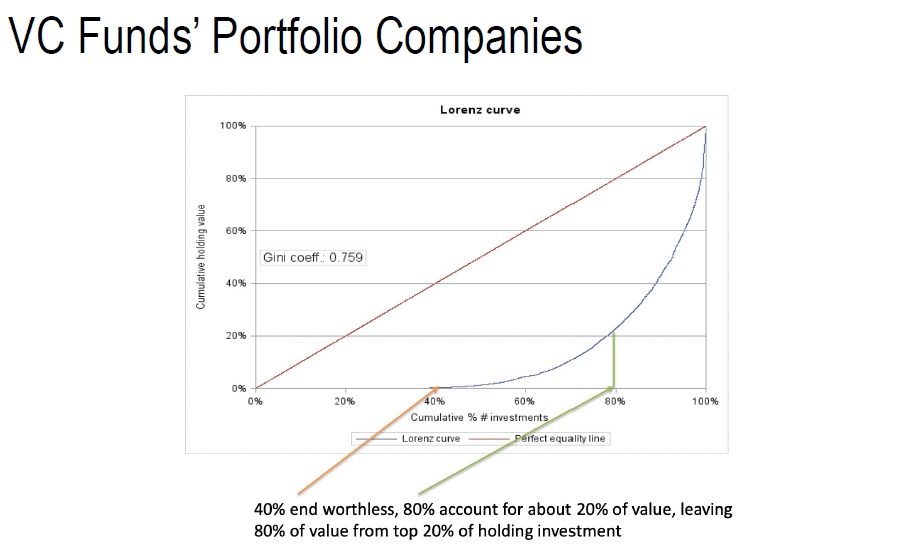 Figure A: The power law distribution in venture fund returns.30
Notes
-
“‘Made in China 2025’ Industrial Policies: Issues for Congress.” Congressional Research Service, August 11, 2020. ↩
-
Tai Ming Cheung. Innovate to Dominate: The Rise of the Chinese Techno-Security State. Cornell University Press, 2022. ↩
-
Ibid. ↩
-
Michael Brown, Eric Chewning, and Pavneet Singh. “Preparing the United States for the Superpower Marathon with China.” The Brookings Institution, April 2020. ↩
-
Christian Brose. The Kill Chain: Defending America in the Future of High-Tech Warfare. Hachette Books, 2020. ↩
-
“How Venture Capital Works,” Harvard Business Review, October 12, 2022. ↩
-
Chris Dixon, “The Babe Ruth Effect in Venture Capital,” cdixon RSS, June 7, 2015. ↩
-
See figure in Appendix A. ↩
-
Aaron Mehta, “'The Math Doesn't Make Sense': Why Venture Capital Firms Are Wary of Defense-Focused Investments,” Defense News, August 19, 2022. ↩
-
Ibid. ↩
-
Molly Ashford, “What Is.... the Valley of Death?,” UNeTech Institute, December 9, 2021. ↩
-
Eric Chewning et al., “How Will US Funding for Defense Technology Innovation Evolve?,” McKinsey & Company, November 8, 2022. ↩
-
Aaron Mehta, “'The Math Doesn't Make Sense': Why Venture Capital Firms Are Wary of Defense-Focused Investments,” Defense News, August 19, 2022. ↩
-
Ibid. ↩
-
Crunchbase, “Anduril Industries.” ↩
-
Crunchbase, “Palantir Technologies.” ↩
-
M. Weinzierl, K. Lucas, and M. Sarang. "SpaceX, Economies of Scale, and a Revolution in Space Access." Harvard Business School Case, April 2020. ↩
-
Crunchbase, “SpaceX”. ↩
-
Ibid ↩
-
M. Weinzierl, K. Lucas, and M. Sarang. "SpaceX, Economies of Scale, and a Revolution in Space Access." Harvard Business School Case, April 2020. ↩
-
M. Schwartz. “Defense Acquisitions: How DoD Acquires Weapon Systems and Recent Efforts to Reform the Process”. May 23 2014 ↩
-
Defense Acquisition University, “Planning, Programming, Budgeting & Execution Process” ↩
-
Congressional Research Service. “Defense Primer: Planning, Programming, Budgeting, and Execution (PPBE) Process” May 20, 2022. ↩
-
Congressional Research Service. “Overseas Contingency Operations Funding: Background and Status”, September 6, 2019 ↩
-
National Defense Industrial Association. “Defense Production Act, Title III Program (50 USC App. § 2091 et seq.)” ↩
-
Department of Energy “President Biden Invokes Defense Production Act to Accelerate Domestic Manufacturing of Clean Energy” ↩
-
Office of the Undersecretary of Defense for Research & Engineering, “Office of Strategic Capital (OSC).” ↩
-
Department of Defense, “Secretary of Defense Establishes Office of Strategic Capital,” Dec. 1, 2022. ↩
-
Gian Gentile, Michael Shurkin, Alexandra T. Evans, Michelle Grisé, Mark Hvizda, and Rebecca Jensen.”A History of the Third Offset, 2014–2018.” The RAND Corporation, 2021. ↩
-
Ilya Strebulaev, Stanford Venture Capital Initiative. 2022 lecture on "PE Economics: PE Returns" ↩